
Why Growing Real Estate Businesses Need Connected Marketing, Sales and CRM Systems
Learn how real estate developers can connect marketing, sales, and CRM systems to improve lead management, automate follow-ups, and track campaign performance.
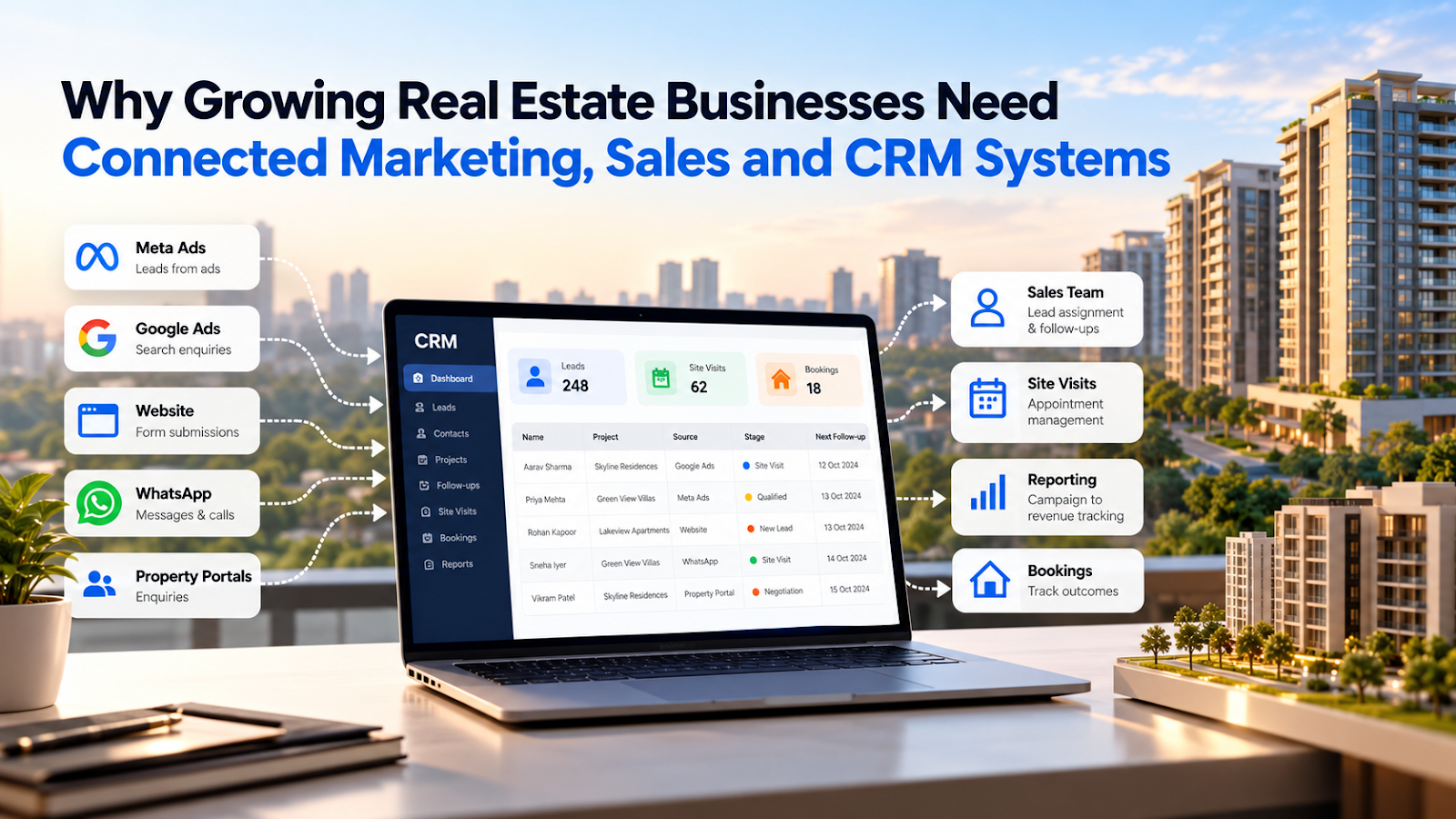
Real estate developers invest in digital advertising, property websites, landing pages and sales teams to generate enquiries. But when these systems operate separately, valuable leads can slip through the cracks.
A prospective buyer may submit an enquiry through a Facebook ad, call the sales office the next day, receive a WhatsApp message later, and still have to repeat their requirements because the information is scattered across different platforms.
The problem is not always a lack of leads. Sometimes, it is a lack of coordination between marketing, sales and customer relationship management (CRM).
Connected marketing, sales and CRM systems help real estate developers manage the buyer journey from the first property enquiry to site visits, negotiations and bookings. They bring lead data, campaign performance, sales activity and follow-up processes into a coordinated system.
For developers managing multiple projects, sales teams or advertising campaigns, this connection can make it easier to identify qualified buyers, respond promptly, track opportunities and understand which marketing activities contribute to business outcomes.
What Are Connected Marketing, Sales and CRM Systems?
Connected systems are digital tools that share relevant information and work together instead of operating as separate platforms.
For a real estate developer, this typically means connecting:
- Marketing platforms: Meta Ads, Google Ads, property portals and email campaigns.
- Website and landing pages: Property enquiries, brochure downloads, callback requests and site-visit bookings.
- CRM software: Lead records, buyer requirements, sales assignments, follow-up history and pipeline stages.
- Communication tools: Business calls, approved WhatsApp messaging, email and appointment reminders.
- Reporting and analytics: Campaign costs, lead quality, site visits, bookings and sales outcomes.
The goal is to maintain a consistent record of each prospective buyer and make that information available to the people who need it.
For example, when someone enquires about a residential project through a landing page, their details can enter the CRM automatically, along with the project name and available campaign information. The system can assign the lead to a salesperson, create a follow-up task and update the lead's status as the sales process progresses.
The exact workflow depends on the tools used, their integration capabilities and the developer's business requirements.
Why Disconnected Systems Create Problems for Real Estate Developers
Real estate sales cycles can involve multiple conversations, property comparisons, financing discussions, site visits and negotiations. Disconnected systems make these interactions harder to manage consistently.
Leads get lost between marketing and sales
Suppose a developer runs campaigns for three residential projects. Enquiries arrive through Facebook Lead Ads, Google Search, property landing pages and phone calls.
If each source is managed separately, salespeople may receive leads through different channels without a unified record. Some enquiries might remain unassigned, while others receive duplicate calls.
A connected process brings these enquiries into one lead management system, subject to the integrations being configured correctly.
Marketing teams cannot see which leads become buyers
A campaign may generate many enquiries but few site visits. Another may produce fewer leads that progress further through the sales pipeline.
If marketing reports only clicks and form submissions, the team cannot reliably compare the quality of leads from each campaign.
Connecting the CRM with campaign tracking helps developers analyse later stages of the buyer journey, not just initial enquiries. Where supported and configured correctly, Google Ads can also use eligible offline conversion data from CRM or sales systems to measure outcomes that happen outside the website.
Follow-ups depend too heavily on individual salespeople
When follow-up reminders exist only in personal notebooks, phone logs or spreadsheets, managers have limited visibility into pending enquiries.
A CRM can record the next action, assign responsibility and flag overdue follow-ups. Automated reminders can support the process, while salespeople still make the personal calls and conversations needed to understand a buyer's requirements.
Management lacks a unified view of performance
If marketing, sales and management maintain different reports, reconciling the numbers becomes difficult.
A connected reporting system can provide a shared view of campaign spending, enquiries, qualified leads, site visits, bookings and pipeline status. Managers can then investigate where leads are dropping out and which projects need attention.
How the Connected Real Estate Lead Management Process Works
A connected system should support the buyer journey from the first interaction through the sales process.
- Lead generation: Prospective buyers enquire through Meta Ads, Google Ads, property portals or the developer's website.
- Centralised lead capture: Contact details, project interest and available source information are recorded.
- CRM assignment: The lead is created or updated and assigned to the appropriate salesperson or team.
- Follow-up and qualification: The salesperson records conversations, budget, requirements and buying timeline.
- Site visit and negotiation: Appointments, attendance, offers and next steps are tracked.
- Booking and reporting: Outcomes are updated, and management reviews performance by project and lead source.
Each stage should update the same lead record wherever possible. This reduces repeated data entry and gives marketing and sales teams a clearer view of progress.
The system should also account for duplicate enquiries, existing customers, consent requirements and leads who contact the business through multiple channels.
Five Essential Integrations for a Growing Real Estate Business
1. Meta Ads and Google Ads with CRM
Connect advertising lead sources to the CRM so enquiries can be captured with relevant source information.
Useful fields include campaign name, ad or form identifier where available, project name, enquiry date and lead status.
This helps the marketing team compare campaigns based on qualified enquiries and downstream sales outcomes rather than lead volume alone.
2. Website and landing page integration
Every property landing page should capture the information needed to respond to an enquiry and route it to the appropriate team.
For example, a landing page for a premium villa project could collect the buyer's preferred configuration, approximate budget range and preferred time for a callback.
The information can then be sent to the CRM if the website platform and CRM support the required integration.
3. CRM and WhatsApp integration
WhatsApp can support enquiry acknowledgements, brochure requests, appointment confirmations and follow-up communication.
An integrated workflow can help the sales team maintain communication history and trigger appropriate messages based on the lead's stage.
Businesses must follow applicable WhatsApp Business Platform policies, consent requirements and template rules. Automation should support relevant communication, not send unsolicited messages to every contact.
4. CRM and sales reporting
A CRM should track the movement of leads through defined stages, such as:
- New enquiry
- Contact attempted
- Contact established
- Qualified prospect
- Site visit scheduled
- Site visit completed
- Negotiation
- Booking completed
- Lost or deferred
These stages should reflect the developer's actual sales process. Clear definitions are essential so different salespeople classify leads consistently.
5. CRM and advertising conversion tracking
Where the necessary data, permissions and technical support are available, CRM outcomes can be connected to advertising platforms.
Eligible offline conversion measurement can help connect an ad interaction with a later outcome, such as a qualified lead or completed sale. This gives marketing teams a more complete picture of campaign performance, although attribution depends on data quality, tracking configuration and platform limitations.
Practical Example: A Developer Marketing Multiple Projects
Consider a developer marketing apartments in one project and independent villas in another. This is an illustrative scenario, not a real client case study.
The marketing team runs separate Meta Ads and Google Ads campaigns for both projects. Without connected systems, enquiries might arrive in different spreadsheets, while the sales team manages follow-ups through personal calls and WhatsApp conversations.
A connected process could work as follows.
Step 1: A buyer submits an enquiry. A prospective buyer requests apartment pricing through a Google Ads landing page. The form records their contact information and project interest.
Step 2: The CRM creates the lead record. The enquiry enters the CRM with the available campaign details. The system checks for a potential duplicate and assigns the lead to the relevant sales team.
Step 3: Sales follows up. The salesperson contacts the buyer, records the budget and preferred configuration, and schedules a site visit if the buyer is interested.
Step 4: Management reviews the outcome. The dashboard shows how many enquiries progressed to qualified leads, site visits, negotiations and bookings, with campaign source information retained where available.
Now imagine the villa campaign generates fewer enquiries but more completed site visits. The developer can investigate whether the villa campaign attracts a more relevant audience, whether the apartment campaign needs better qualification, or whether differences in pricing and buyer preferences explain the results.
The important point is that marketing decisions can be informed by sales outcomes instead of lead volume alone.
The Metrics Real Estate Developers Should Track
https://chatgpt.com/s/w_6adf998157f08191a82c93f19d14112e
A useful reporting system should connect advertising activity with the stages that matter to the business.
- Cost per lead (CPL): Average advertising cost for generating an enquiry.
- Cost per qualified lead: Cost of generating an enquiry that meets defined buying criteria.
- Lead response time: How quickly the sales team responds.
- Contact rate: Percentage of leads successfully contacted.
- Site visit rate: Percentage of leads who attend a site visit.
- Site visit-to-booking rate: Percentage of completed site visits that result in bookings.
- Cost per booking: Advertising cost associated with a recorded booking, using a defined attribution method.
- Campaign-to-revenue attribution: Which marketing sources are associated with recorded sales revenue.
These metrics need consistent definitions. A scheduled site visit and an attended site visit should be reported separately.
Likewise, cost per booking should account for the reporting period, attribution model and treatment of shared or repeat leads. It should not automatically be interpreted as the complete cost of acquiring a customer.
For developers with longer sales cycles, tracking lead cohorts over time can also help reveal whether recent campaigns are generating prospects who convert later.
How to Implement Connected Systems Without Overcomplicating Your Business
You do not need to replace every existing tool or purchase an expensive enterprise platform at the beginning. A phased implementation is often more practical.
Phase 1: Audit your current process. List the advertising platforms, property portals, websites, spreadsheets, CRMs and communication tools your teams already use. Identify where lead data is duplicated or lost.
Phase 2: Standardise lead data. Define common fields, project names, source labels, lead statuses and qualification criteria. Clean existing records where practical.
Phase 3: Connect the highest-priority lead sources. Start with the channels that generate the most enquiries. Test whether records arrive correctly, source information is retained and assignments work as intended.
Phase 4: Introduce follow-up workflows. Configure ownership, reminders, appointment updates and relevant communication. Keep a clear record of what has been sent and what action the salesperson must take.
Phase 5: Build management reporting. Begin with a small set of reliable metrics. Check that the dashboard reconciles with actual CRM records and advertising spend.
Phase 6: Improve campaign measurement. Once the data is reliable, explore importing eligible qualified-lead and booking outcomes into advertising platforms where supported.
At every stage, assign someone responsibility for data quality, integration failures and CRM adoption. A technically connected system will still underperform if salespeople do not update lead statuses or if campaign tracking is inconsistent.
Common Mistakes to Avoid
Growing real estate businesses should watch for these problems:
- Buying software before defining the process. A new CRM will not automatically fix unclear responsibilities or inconsistent sales practices.
- Tracking only lead volume. Cheap enquiries do not necessarily represent genuine buyers.
- Over-automating communication. Repeated or irrelevant messages can damage the buyer experience.
- Ignoring duplicate leads. The same buyer may enquire through multiple campaigns or channels.
- Using inconsistent reporting definitions. Different teams may count qualified leads, site visits or bookings differently.
- Connecting systems without testing them. Failed integrations, missing source data and incorrect assignments can undermine reporting.
- Neglecting data security. Restrict access to buyer information, use appropriate safeguards and follow applicable privacy and communication requirements.
The objective is not to automate every activity. It is to make important information available, ensure the right action happens at the right time, and give management a reliable view of performance.
How DigiLads Can Help Real Estate Developers
Real estate growth requires more than generating enquiries. Marketing platforms, websites, sales processes and CRM systems need to work together so that leads can move through a clearly managed journey.
DigiLads helps businesses approach digital growth through marketing, lead generation, automation and connected business systems. For real estate developers, the right solution depends on the current technology stack, number of projects, lead volume, sales processes and reporting requirements.
A practical starting point is to review your existing setup and identify where enquiries are getting delayed, duplicated, overlooked or disconnected from campaign performance.
From there, you can prioritise the integrations and workflows that address those specific problems instead of adding tools without a clear purpose.
If your team is generating property enquiries but struggling to track follow-ups, assess lead quality or connect advertising spend with sales outcomes, contact DigiLads to discuss your current process and identify the next steps toward a more connected marketing and sales system.
Frequently Asked Questions
What is a connected marketing and CRM system in real estate?
It is a setup in which advertising platforms, property websites, CRM software, communication tools and reporting systems share relevant information. It helps developers manage enquiries and track their progress through the sales pipeline.
Why do real estate developers need CRM integration?
CRM integration can reduce manual data entry, centralise enquiries, improve lead assignment, support consistent follow-ups and connect marketing activity with sales outcomes. The actual benefits depend on implementation quality and team adoption.
Can Meta Ads and Google Ads connect to a real estate CRM?
Yes. Many CRM systems support connections with Meta and Google advertising tools, directly or through integration platforms. Available functions vary, so developers should verify lead capture, source tracking, offline conversion measurement and required permissions for their specific setup.
Can WhatsApp automation help convert property leads?
WhatsApp automation can support timely enquiry acknowledgements, brochure delivery, appointment reminders and relevant follow-ups. It works best when messages reflect the buyer's interests and comply with applicable messaging policies and consent requirements.
Which CRM is best for real estate developers in India?
There is no single best CRM for every developer. Compare options based on lead-source integrations, project and inventory management, sales pipeline customisation, calling and WhatsApp support, reporting, access controls and total cost.
How can developers measure the quality of digital marketing leads?
Track qualification criteria, successful contact rates, site visits, negotiations and bookings alongside cost per lead. Use consistent definitions and retain campaign source data so you can compare channels on meaningful outcomes.
Do small real estate developers need marketing automation?
Not necessarily at the beginning. A small developer can start with a well-maintained CRM or spreadsheet, clear follow-up ownership and reliable reporting. Automation becomes more useful as lead volume, project complexity and coordination needs increase.
How long does it take to integrate marketing, sales and CRM systems?
The timeline depends on the number of platforms, API availability, data quality, workflow complexity and testing requirements. A basic lead-capture integration may be simpler than a setup involving multiple projects, WhatsApp workflows, offline conversion tracking and management dashboards. A proper assessment is needed before estimating delivery time.
Continue Exploring DigiLads Insights
Discover more playbooks on CRM integration, marketing attribution, and conversion systems.
Browse Insights LibraryReady to Put These Insights to Work? Request an AI Growth Audit.
Our systems architects will evaluate your conversion pipeline and design a custom automation roadmap.